


The 'pop up' station test
20 stations for 20 communities
Frustrated at the slowness of appraising the case for a new station, the Scottish Greens propose deploying temporary modular 'pop-up' stations to test passenger demand. They suggest this is a far more accurate way to assess the viability of a station than hypothetical guesswork modelling. If the case is made a popup could become a permanent fixture. If not, it can be easily removed and used elsewhere.
The idea was first suggested in a report commissioned by the Scottish Greens back in 2017. it was one of a number of ideas made in response to the party's concern that no new rail projects had been proposed by Transport Scotland since its inception back in 2012.
Consultants Allan Rail were commissioned to propose project ideas. One was to install a test or pop-up station at 20 sites across the rail network. They could generate
real-time data on how many people actually used the station, when they used it and with additional research why they were using it.
Real data versus educated guesswork?
The popup was a very practical alternative to the frustratingly slow STAG* appraisal process used by Transport Scotland to assess the viability of a proposed station. A key element of the appraisal is modelling passenger numbers. Some argued that at best this is just well considered, educated guesswork. Some argue the model is prone to error.
In January 2023, the Beattock Station Action Group, campaigning to reopen a station in Dumfries, had their business plan (STAG) rejected by Transport Scotland. The group, local businesses and politicians hotly contested the outcome with particular criticism of predicted passenger numbers.
A real station would generate a far more accurate picture of use and reasons for use
A popular idea with Government
The pop up station ideas was broadly welcomed by the Government. Finance secretary Derek Mackay later agreed to consider a new “pipeline” fund of up to £2 million to develop new stations and lines. Transport Scotland stated they were aware of this proposal and were giving it consideration.
No pop up station were ever deployed in Scotland
In 2024, in Dumfries, the campaign for a new station at Beattock, the site of a proposed popup station, was controversially rejected by Transport Scotland. The decision has been heavily criticised by local business, politicians and the Beattock community. The figures presented in the decision for passenger growth was hotly contested.
Perhaps if the popup station had been used a more accurate figure could have been reached.
Time to reconsider popups?
The climate crisis, is promoting the government to encourage more sustainable travel . It wants more car drivers to switch to rail and in Scottish urban environments, comprehensive train and bus transport systems are being developed to provide for this. But for the 17% of people living in urban or semi-urban regions provision of sustainable travel remains in many places, inadequate. Public service buses, often the only way to get around., simply do not attract sufficient passengers.
Access to the train network is often limited and this despite many rural communities being close to active train lines. Would having access encourage more car drivers to swap their cars and travel by train? The government and indeed Transport Scotland appear to think so. But with the rail station appraisal process being so desperately slow perhaps it is time for the government to step and revive the idea of the popup station.
Nearly all new stations see passenger numbers exceed predicted figures. A popup will mostly justify the need for a station and morph into a permanent hugely important means to connect people and bring prosperity to a community.
Simple modular popups
Modular rail stations are pre-fabricated, factory-built, designs. They are cheap, easy to assemble and environmentally friendly when compared to standard station design. Today, modular design methods are an integral part of Network Rail station builds.
A popup station could employ this now a commonly used design method used by Network Rail. The station is a 'bare bones' halt with one or two short platforms, a ticket machine a shelter, an led timetable and full access and for all.
If the 'test' concludes with a positive outcome, the modular popups can stay in situ and be expanded to provide a proportionately-sized permanent station. If passenger figures are low then a modular popup can be easily removed and deployed elsewhere.
20 sites were identified across the network. Some were already been promoted by station campaigners as a good site for a station. Others were selected based on nearby population figures and socio/economic growth forecasts.
Most sites were in rural or semi-rural locations - areas often distanced from rail travel even when train lines runs close to or even through their communities.
The Welsh Government recently unveiled an ambitious plan to deliver an integrated, high-frequency public transport network in North Wales. The vision is to re-energise the region by attracting news businesses and people to the region and to encourage more people to travel by rail.
For this, the government aims to reopen closed stations and creating new stations in employment growth areas. One such area is the Deeside Industrial Park. 10,000 people current work at a site only accessible by road.
Ken Skates, the Welsh Transport Minister wants to bring back rail services to the estate. “My proposal is that we bring in a temporary test station, and that will then justify to Network Rail introducing this sort of innovation', he said. He sees huge uptake in train travel. “There is incredible potential patronage for a service, if there is a station at the heart of Deeside Industrial Estate. Pretty much everybody on that industrial estate has to drive to work, with no other choice.”Skates said having the test station could help Network Rail, that might be wary of “calls from communities across the length and breadth of Britain”.

A popup test station in Wales
*STAG stands for Scottish Transport Appraisal Guidance
Hawarden Bridge - the station to close
A tradition station built
Rail Stations were one time built brick-by-brick, requiring teams of skilled people - such as bricklayers, joiners, plasterers - to get it done. Costs accrued as teams of skilled workers needed paying and numerous lorries supplied the raw materials needed. The number of trucks needed to deliver all the material made it costly for the environment too.
Network rail, who manage British rail infrastructure sough a better, cheaper more environmentally friendly way to build stations.
In 2008 they built the first UK modular station at Greenhithe in Kent. It was simpler and cheaper and more environmentally-friendly than tradition station builds. Today, modular design is a very standard way to build rail infrastructure.
Network Rail's HUB station: designing new small stations quickly and simply
Today, modular design is an integral part of the Network Rail's HUB station concept - an adaptable station design developed for building small or medium sized stations.
The HUB concept began in 2018. It was developed to meet the need to build up to 100 new stations over the following five years. Network Rail had to deliver these stations at scale., for low cost while not compromising quality or safety.
Their response was to develop the HUB design concept.
The core design element is what is called the “kit of parts” - a set of pre-designed components that can be combined and configured to suit different stations.
HUB stations are modern, efficient and sustainable, with features like timber and low-carbon materials, and solar-panelled canopies for renewable energy.
The components tat make up the “kit of parts” are made in factories, making construction faster, cheaper, more flexible, and easier to expand or adapt later.

Examples of modular stations and platforms
Robroyston, Glasgow

significant savings made - innovative construction methods and collaborative working, led to cost efficiencies. More >>>
Livingstone South, Scotland

Two new modular platforms in just 10 days - Existing platforms were demolished and replaced with one platform extended to accommodation longer trains. More >>>
Maghull North, Merseyside

Built in just 9 months - The £13 station is a fully-featured, two platformed station including a station building, bridge, and lift shafts.
Castle Bar Park Station, London

Build at the bottom of an embankment - An award-winning, short-platformed modular design.

The benefits of modular station design
The advantages of Modular station design
-
Off-site fabrication - of components allows much of the work to be done concurrently with on-site preparation. These factory made components are cheaper than conventional material and often lighter too.
-
Stations can be assembled quickly - Stations can be assembled on site with minimal disruption to train services or nearby road traffic. Assembly does not teams of skilled workers. It is for the most part labour intensive.
-
Standardised designs - reducing architectural and engineering costs. The Network Rail HUB approach to station design standardises the design approach, and the components used.
-
Standardised parts - and layouts simplify inspections, repairs, and upgrades. and make expanding a station easy.Reusable components - offer an economy of scale lead to lower construction and maintenance costs.
-
Less waste - Modular construction typically generates less waste.
-
Recycled material - Some providers of modular station designs increasing use eco-friendly materials like energy-efficient lighting or solar panels and recyclable materials including old wind turbine blades!
-
Less on-site work - means fewer risks to workers and disruption to rail services.
What a modular station is
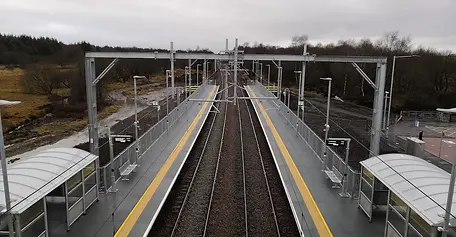
Modular stations is made of pre-fabricated, factory-built, light-weight component ( or modules) that are transported and assembled on-site. Assembling and deploying a station is often quick and relatively easy. The environmental impact of modular design when compared to traditional brick and mortar builds is far less.
The modular approach is often combined with more conventional rail-station construction methods - where prefabricated components are incorporated into a more standard build.
Off site construction of both modular and and more standard elements of construction like concrete blocks reduces both the cost of materials and the time taken to build a station. Maghill North station, a two platform fully featured station near Liverpool was build in just nine months.

Maghill North station on Mersey Rail near Liverpool
And it can be tested as an idea!
A halt not a station
The term halt is being increasingly used to distinguish a small stop with minimal infrastructure from a larger fully-featured station. An unmanned halt can comprise little more than a short-form platform, a ticket machine, a shelter and an electronic timetable.. Designs are fully accessible,
Many smaller rail stations were once entitled 'halts'. The term was removed from timetables by British Rail in 1974 but came back in 1978 for the opening of the IBM Halt in Greenock in Scotland.
The campaign proposes Newburgh adopts a short-platform halt. - cheap, easy-to-assemble means to connect to rail.
Beauly Station
A big hit with local commuters

Following a local campaign, Beauly station was reopened in 2002. It is a short-form design with a one 10m length, single platform.The new single platform, shelter and car park were built as part of a £250,000 project (£453K in today's figures*). The reopening of the station prompted 75% of local commuters to switch from road to rail. Beauly shows what can be achieved on a modest budget.
Conon Bridge
A cost-effective success

In 2012, the Scottish Government announced that a new station £600,000 (£845,000 in today's figures*)with a single, carriage-length platform, would be built at Conan Bridge. It opened in early 2013 on budget.In the month following the station's opening, more than 2,000 journeys were made to or from it. According to the then Minister for Transport, Keith Brown, the numbers "show that it was an extremely worthwhile investment".