


A simple station for Newburgh
Cost effective modular stations
Suggested costs for a new Newburgh station sit between £4 and £6m. But could it be done for less? Would a simple, 75m long modular design be a more proportionate and affordble way to reconnect the community to rail?

New modular platforms at Livingston South assembled on site in just 10 days, Photo by Dura Composites
Modular rail stations are pre-fabricated, factory-built, designs. They are cheap, easy to assemble and environmentally friendly when compared to standard station design. Today, modular design methods are an integral part of Network Rail station builds
A tradition station built
Rail Stations were one time built brick-by-brick, requiring teams of of bricklayers, joiners, plasterers and skilled workers to complete. Costs accrue as these workers needed paying and numerous lorries supplied the raw materials required. The number of trucks needed to deliver all the material made it costly for the environment too.
Network rail, who manage British rail infrastructure sought a better, cheaper more environmentally friendly way to build stations.
In 2008 they built the first UK modular station at Greenhithe in Kent. It was simpler and cheaper and more environmentally-friendly than tradition station builds. Today, modular design is a very standard way to build rail infrastructure.
Network Rail's HUB station: designing new small stations quickly and simply
Today, modular design is an integral part of the Network Rail's HUB station concept - an adaptable station design developed for building small or medium sized stations.
The HUB concept began in 2018. It was developed to meet the need to build up to 100 new stations over the following five years. Network Rail had to deliver these stations at scale., for low cost while not compromising quality or safety.
Their response was to develop the HUB design concept.
The core design element is what is called the “kit of parts” - a set of pre-designed components that can be combined and configured to suit different stations. HUB stations are modern, efficient and sustainable, with features like timber and low-carbon materials, and solar-panelled canopies for renewable energy.
The components tat make up the “kit of parts” are made in factories, making construction faster, cheaper, more flexible, and easier to expand or adapt later.
What is a modular station?
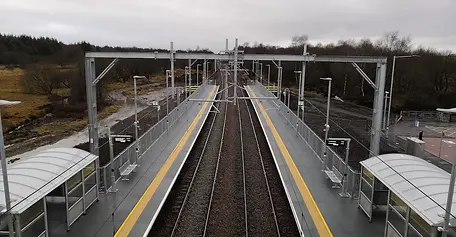
Modular stations is made of pre-fabricated, factory-built, light-weight component ( or modules) that are transported and assembled on-site. Assembling and deploying a station is often quick and relatively easy. The environmental impact of modular design when compared to traditional brick and mortar builds is far less.
The modular approach is often combined with more conventional rail-station construction methods - where prefabricated components are incorporated into a more standard build.
Off site construction of both modular and and more standard elements of construction like concrete blocks reduces both the cost of materials and the time taken to build a station. Maghill North station, a two platform fully featured station near Liverpool was build in just nine months.

Maghill North station on Mersey Rail near Liverpool
The benefits of modular station design
Network rail recognises the modular design approach as the smart way to build and deploy new stations. Their HUB station concept, is a 'kit of parts' approach to assembling a station from the same components. There are other advantages too -
-
Off-site fabrication - of components allows much of the work to be done concurrently with on-site preparation. These factory made components are cheaper than conventional material and often lighter too.
-
Stations can be assembled quickly - Stations can be assembled on site with minimal disruption to train services or nearby road traffic. Assembly does not teams of skilled workers. It is for the most part labour intensive.
-
Standardised designs - reducing architectural and engineering costs. The Network Rail HUB approach to station design standardises the design approach, and the components used.
-
Standardised parts - and layouts simplify inspections, repairs, and upgrades. and make expanding a station easy.Reusable components - offer an economy of scale lead to lower construction and maintenance costs.
-
Less waste - Modular construction typically generates less waste.
-
Recycled material - Some providers of modular station designs increasing use eco-friendly materials like energy-efficient lighting or solar panels and recyclable materials including old wind turbine blades!
-
Less on-site work - means fewer risks to workers and disruption to rail services.
Stations built in a day...
There are many examples of stations assembled in short order. Though this often follows years of business case development, feasibility studies and design!
Robroyston, Glasgow
A community success story

photo: Dura Composites
A cost-efficient build
significant savings made - innovative construction methods and collaborative working, led to cost efficiencies. More >>>
Livingston South, Scotland
Helping make it a good place to live

photo: Ewan Rutledge
Two new modular platforms in 10 days
Existing platforms were demolished and replaced with one platform extended to accommodation longer trains. More >>>
Maghull North, Merseyside
A completed station in just 9 month

photo: Roger French
Built in just 9 months
The £13m station is a fully-featured, two platformed station including a station building, bridge, and lift shafts.
A halt not a station
The term halt is being increasingly used to distinguish a small stop with minimal infrastructure from larger stations. An unmanned halt can comprise little more than a short-form platform, a ticket machine, a shelter and an electronic timetable.. Platforms are always fully accessible,
Many smaller rail stations were once entitled 'halts'. The term was removed from timetables by British Rail in 1974 but came back in 1978 for the opening of the IBM Halt in Greenock in Scotland.
The campaign proposes Newburgh adopts a short-platform halt. - a cheap, easy-to-assemble means for Newburgh to connect to rail. It keeps costs low and is a proportionately sized station for the town.
Short station stories
Beauly Station
A big hit with local commuters

Following a local campaign, Beauly station was reopened in 2002. It is a short-form design with a one 10m length, single platform.The new single platform, shelter and car park were built as part of a £250,000 project (£453K in today's figures*). The reopening of the station prompted 75% of local commuters to switch from road to rail. Beauly shows what can be achieved on a modest budget.
Conon Bridge
A cost-effective success

In 2012, the Scottish Government announced that a new station £600,000 (£845,000 in today's figures*)with a single, carriage-length platform, would be built at Conan Bridge. It opened in early 2013 on budget.In the month following the station's opening, more than 2,000 journeys were made to or from it. According to the then Minister for Transport, Keith Brown, the numbers "show that it was an extremely worthwhile investment".
Small is beautiful
Chetnole, Wiltshire
a community success story

Chetnole station in Wiltshire is not a typically measure of rail "success". Passenger numbers are modest. but this unmanned, simple, 45m request stop station is a vital community resource and if judged by it's value to connecting the community to the wider world then it is certainly a success.
Syston, East Midlands
Making the town a good commuter option

photo: Ewan Rutledge
The station's success is measured by its local utility and ongoing infrastructure support. It does not record high passenger numbers.
Syston itself is described as a desirable place to live with good transport links, suggesting the station plays a crucial role in its suburban convenience.
Berney Arms station, Norfolk
a quirky success story

photo: Roger French
The station saw an eight-fold increase in passengers s due to line reopenings in 2021. But the station remains remote which is part of its charm.
This low maintenance stop is a popular step off point for tourists visiting the Norfolk Broads. While not a success story if told by numbers, Berney Arms shows the reach a simply station can provide.